Purpose
Why force is organized—and who may authorize it.
 KidunaDesign systemsAll systems ←
MAPSHIFTING SYSTEM 12 · ENGINE 1.3
First Field edition · 27 August 2026Purpose organizes force. Force consumes worlds. Consequence returns through bodies, families, landscapes, institutions, and memory.
Not a catalog of weapons. A living graph of power, service, sustainment, consequence, care, and return.


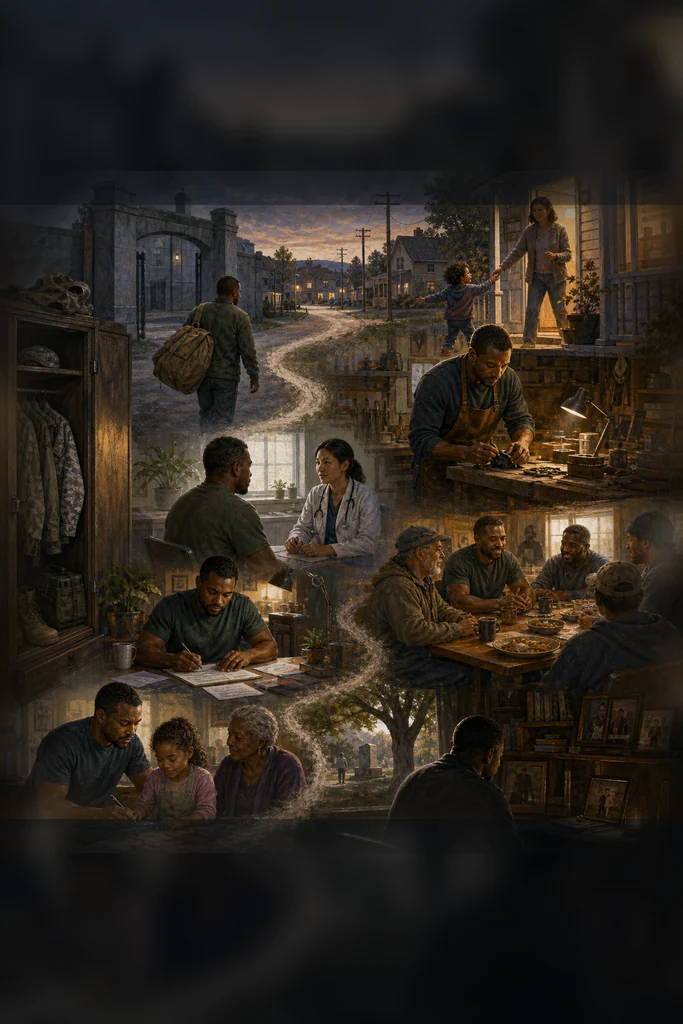
THE LONG FIELDPower does not end where the battle map ends.
ONE SYSTEM · MANY CLOCKS
Military power is a relational field joining political purpose, authority, people, command, logistics, law, technology, medicine, environment, opposition, aftermath, and memory. The System keeps those maps connected without pretending one viewpoint contains them all.
THE COMPLETE PASSAGE
Why force is organized—and who may authorize it.
People, command, law, training, matter, information, and time.
A tactical event inside a larger campaign and political field.
What continues after the institution’s formal boundary.
Health, benefits, family, community, and qualified handoffs.
How consequence returns, is contested, and becomes public meaning.
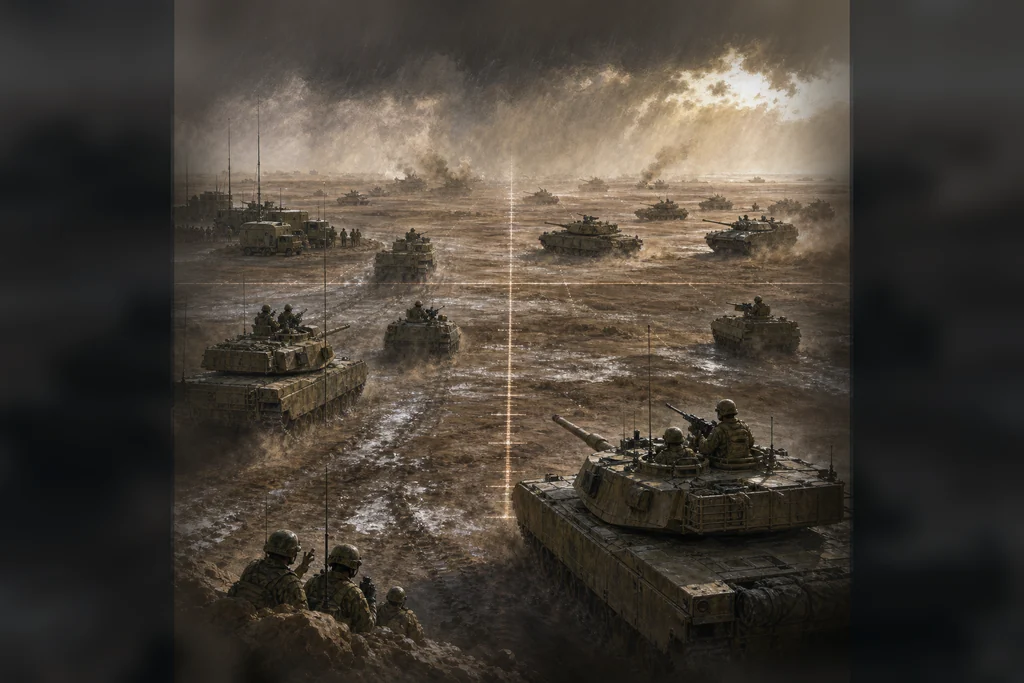
26 FEBRUARY 1991 · 2D ACR
Official U.S. Army histories place the 2d Armored Cavalry Regiment at the front of VII Corps’ advance, fighting Iraqi forces associated with the Tawakalna and 12th Armored Divisions. The card follows reconnaissance, weather, training, command, sustainment, opposition, and passage of lines—then refuses to stop at tactical victory.
THE SYSTEM AFTER THE SYSTEM
Veteran is a status and a field of situated experiences—not one archetype. The graph keeps service, health, benefits, work, family, grief, humor, purpose, and memory connected while preserving privacy and participant authority.
VETERANS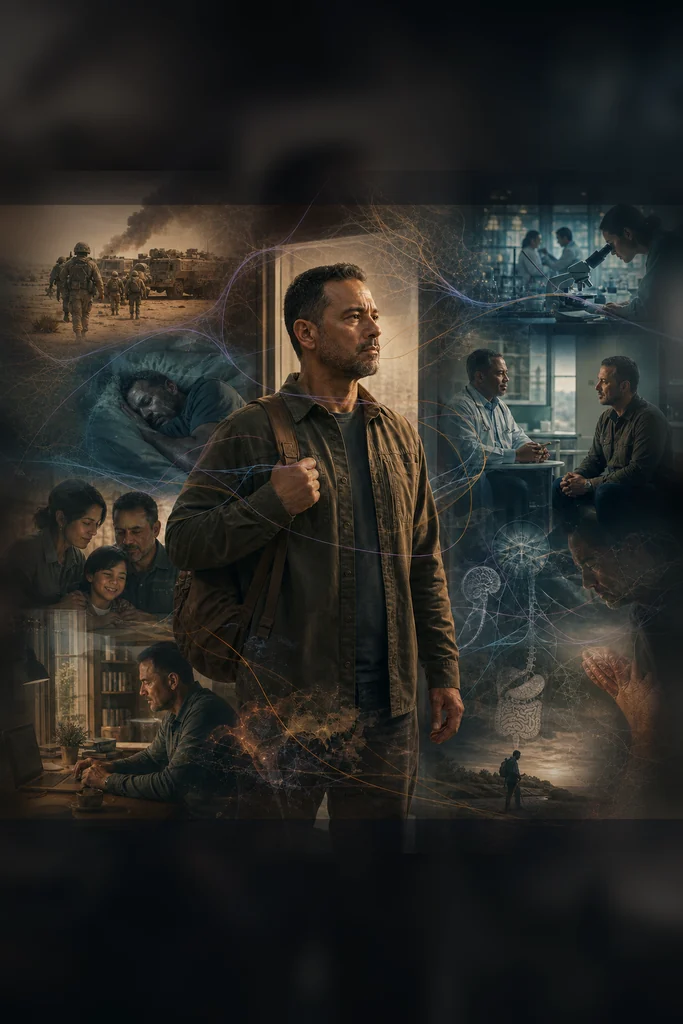 GULF WAR ILLNESS
 VA NAVIGATION
THE FIRST FIELD DECK
Portrait favors focal identity. Landscape reveals relation, passage, and consequence. Open any card for its moving directions, four-stage capability, and smallest live question.
01 · SystemPurpose organizes force; consequence returns through bodies, families, landscapes, institutions, and memory.
Open the complete card +Whole-field orientation makes hidden dependencies and deferred consequences visible.
Totalizing abstraction can make particular people, responsibilities, sources, and disagreements disappear inside the word system.
Name the boundary, purpose, participants, resources, forces, clocks, perspectives, and unknowns.
Compare capability, legitimacy, sustainment, human consequence, reversibility, and information gained.
Require authority, interfaces, receipts, stopping conditions, and remedy.
Compare expected and observed outcomes, including effects shifted onto civilians, Veterans, families, and environments.
Which part of the field has declared itself the whole?
03 · BattleA map grid line became a threshold where reconnaissance, command, training, weather, sensors, weapons, logistics, and Iraqi resistance converged on 26 February 1991.
Open the complete card +Study interaction among mission, mutual support, initiative, reporting, training, weather, sustainment, Iraqi action, and adjacent formations.
A decisive-battle story can let one technology, leader, troop, or national account stand in for the action and its aftermath.
Reconstruct mission, map, weather, visibility, locations, reports, uncertainty, opposing action, and source perspective.
Compare decisions available at each echelon without giving historical actors hindsight.
Use only for history, education, and public analysis—not contemporary targeting or tactical instruction.
Separate lessons claimed at the time from doctrine, simulation, memory, official history, and unresolved perspectives.
What disappears when the action ends at tactical victory?
04 · VeteransMilitary service continues after separation through bodies, identity, families, work, disability, care, benefits, community, grief, humor, and memory.
Open the complete card +Recognition, participant agency, useful continuity, peer and family connection, renewed purpose, and authority over what is shared.
Abandonment, identity capture, compulsory heroism, compulsory damage, isolation, or one memory made to speak for everyone.
Ask what continues, what changed, what remains private, and which institution has actual authority.
Include passing, joking, staying literal, asking for current information, contacting a peer, or seeking qualified help.
Use explicit participant-authorized handoffs; keep private health, benefits, and family details out of the shared graph.
Let correction and dissent remain attributable; a story may deepen the System without becoming universal truth.
What did the institution end on paper that continued in life?
05 · CareA varied cluster of chronic symptoms can remain consequential even when one cause, test, or universal case definition does not contain every Veteran’s experience.
Open the complete card +Recognition, individualized evaluation, current navigation, symptom-specific care, participant credibility, and qualified research.
Dismissal because causation is uncertain; diagnosis by card; one-cause certainty; stereotypes; or stale eligibility rules.
Separate symptoms, diagnoses, exposure concerns, research definitions, benefits rules, participant statements, and unknowns.
Consider qualified care, an environmental-health coordinator, the Gulf War Registry, or current benefits help as appropriate.
Route to qualified care or official and accredited help; the card cannot diagnose, treat, or determine service connection.
Preserve what helped and what remained unresolved without turning one experience into the cohort.
Which uncertainty is being mistaken for permission to dismiss the person?
06 · CareA registry exam, health-care enrollment, clinical referral, disability claim, accredited representation, Vet Center service, and crisis response are different doors.
Open the complete card +Current official information, the correct program, a human contact, clear records, consent, a receipt, and a visible remedy path.
Stale rules, duplicated forms, dropped handoffs, informal authority, missing records, or symbolic reflection mistaken for eligibility.
Identify the actual question: health, registry, referral, enrollment, claim, appeal, accredited help, counseling, family support, or crisis.
Compare current pathways and what each requires; the fitting move may be a warm handoff rather than another document.
Make only participant-authorized connections; do not submit, disclose, or decide on someone’s behalf.
Record whether the handoff connected and what remedy exists—without copying private details into the graph.
Which door has authority to answer this question?
 07 · Crisis
During a suicidal crisis, immediate connection, safety planning, and greater time or distance from lethal means can open space for care; the card is a doorway, never the responder.
Open the complete card +Immediate human connection, hope, time, safety planning, support networks, a qualified responder, and greater distance from lethal means.
Isolation, delay, shame, compelled disclosure, method detail, unattended risk, or an automated system substituting for support.
Recognize that urgent support may be needed without assigning a personal score or demanding a story.
Offer current qualified channels appropriate to the moment.
Make the human handoff now and follow the qualified responder’s safety guidance.
Later, review whether the pathway was accessible and continuous without storing private crisis details.
What safe human connection can create the next hour?
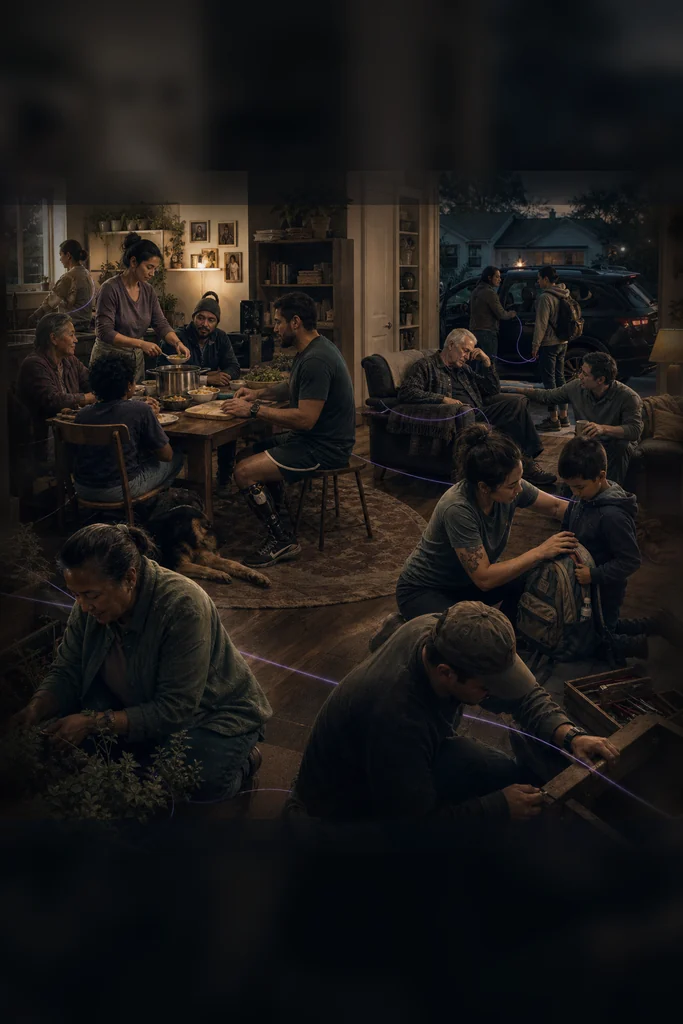 08 · Families
Families and chosen networks often carry scheduling, care, records, transportation, income shocks, grief, advocacy, and ordinary continuity after formal systems recede.
Open the complete card +Visible and shared care labor, consent, boundaries, respite, resources, mutual support, and institutional responsibility.
One person becomes the permanent driver, scheduler, recorder, advocate, translator, income buffer, historian, and crisis system.
Ask who carries which work, with what resources, authority, consent, time, and strain.
Include boundaries, respite, redistribution, official navigation, peer support, professional care, or saying no.
Make participant-authorized handoffs and protect private information.
Notice which support helped, which burden moved rather than disappeared, and what the institution must repair.
Which system is functioning only because a household absorbs its failures?
If this page matters because a Veteran may be in immediate danger or thinking about suicide, stop the reading and connect to qualified help now.
In immediate danger, call 911 or go to the nearest emergency department.
INSPECTABLE BY DESIGN
The page uses current official sources for Gulf War illness terminology, VA pathways, Vet Center eligibility, and crisis support. “Gulf War Syndrome” remains searchable, but the display follows current VA language: Gulf War illness.
Historical, educational, symbolic, and reflective—not military advice, tactical instruction, diagnosis, treatment, crisis response, legal advice, or a VA eligibility determination. Current decisions require authorized institutions and qualified people.