Purpose first
Name the Realm, Scene Purpose, intended Activities, Sources and authorized intelligence before drawing geometry.
 Isometric Scene System
07 / SCENE COMPOSITION
A Scene is not flattened art with hotspots. It is a layered, stateful arrangement whose visual and semantic structures agree.
10-step assembly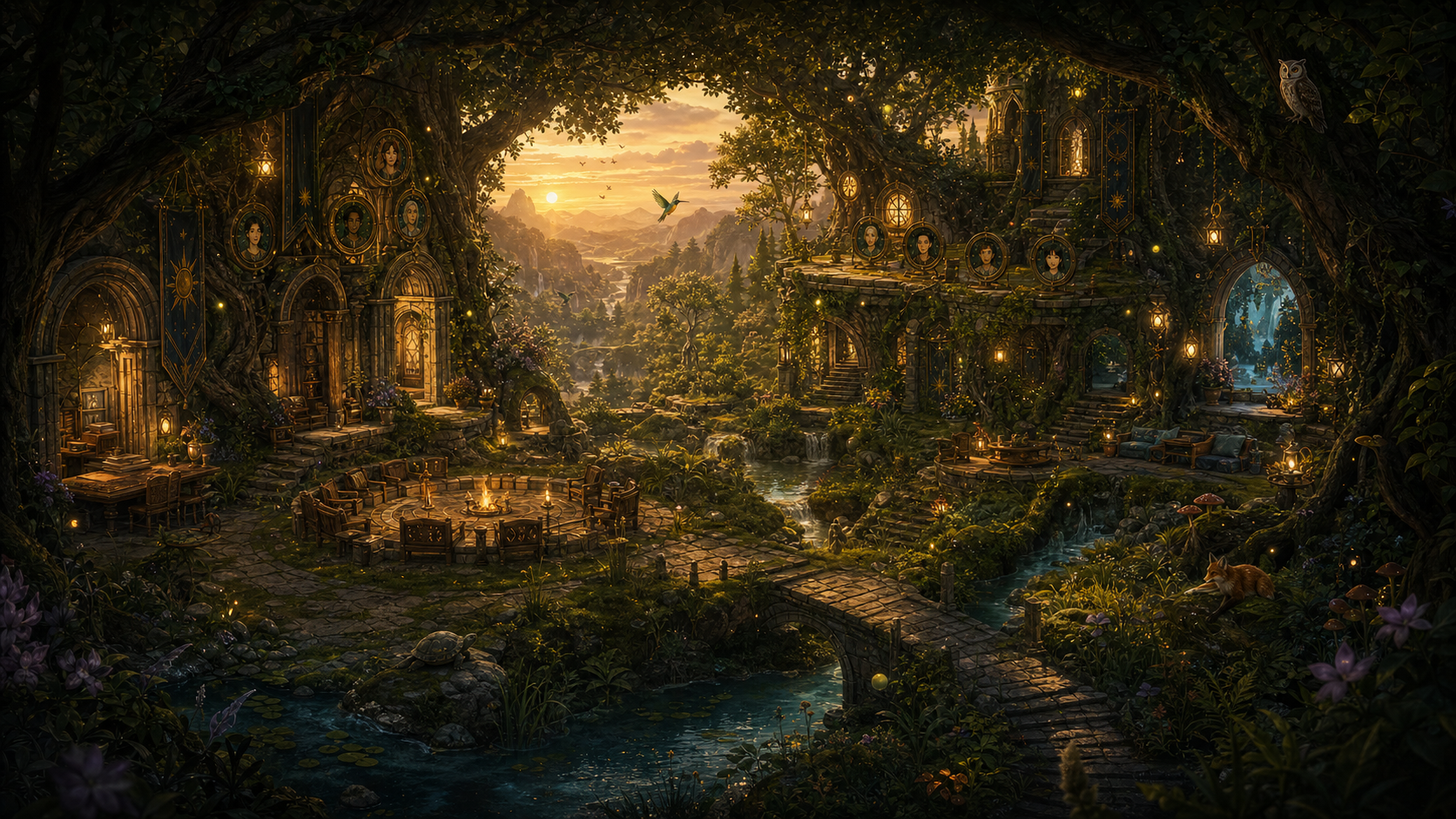
BACKGROUND → STRUCTURE → GROUND → OBJECTS → ENTITIES → EFFECTS → PANEL → OVERLAY
Name the Realm, Scene Purpose, intended Activities, Sources and authorized intelligence before drawing geometry.
Choose horizon, weather, time and principal environmental light. These govern every later color and shadow decision.
Establish dark peripheral architecture or nature, one inhabited center, and at least two continuations beyond viewport.
Build traversable and non-traversable fields, platforms, stairs, water and seam-hiding transition zones.
Use one dominant gathering, work, navigation, governance, exchange or custody form. Secondary forms support it.
Snap typed anchors, respect scale, compute depth, resolve collisions and connect materials to their surroundings.
Choose contextual Avatar, Ki, Ally and Actor embodiments. Arrange Affinity, Attention and Authority spatially.
Composite ambient, key, local, rim, shadow and reflection. Add depth haze and foreground framing.
Use quiet environmental loops and world response. Overlays enter only when the Scene cannot speak clearly enough.
Test silhouette, focus, occlusion, contrast, accessibility, alpha, state transitions and a second lighting condition.
COMPOSITION RATIOS
70% environmental continuity · 20% meaningful interactive structure · 10% explicit informational treatment. These are starting constraints, not fixed coverage metrics.
ATTENTION BUDGET
One organizing form may dominate. Up to three secondary pools of light may compete gently. Everything else breathes beneath the current Purpose.
Aesthetic integrity is recomputed when Components move: depth key, occlusion, shadow receivers, local-light influence, reflection tint, overlap density and Attention prominence must all update together.